The cost of a life in Baroque Naples
In 1600, Napoli was the second-most populous city in Europe, with about 250,000 people. Could you have afforded to live there?
A man, half human, half chair. The portiere. Not a mythological figure but a real one. Today, you’ll call them the doorman; back then, you called it the gatekeeper. There were more gates than doors, I guess. If you grew up in Naples, you’d know that the portiere would spend most of his time sitting on a wooden chair, positioned right outside his apartment, facing the main entrance: a tall, arched stone, with no door or gate at all. He was the actual door-man.
He’d question anyone who dared to step in; he’d know everyone’s name among the people living in the cortile. Not just their names and faces, though, but also their lives, their secrets, and their sons, grandsons, and siblings’ secrets. But he’d keep it to himself, mostly, but when revealed, he knew exactly how to do it: with discretion, without mentioning names, for it’s always the story that matters, not the character.
You can still see them if you happen to walk through the vicoli — alleys —of Naples.
This chair figure existed as early as the 1600s. And you’d find them in front of the Banco di Napoli, scanning each person from head to toe before they’d step into the bank. He’d hold the door ajar with his foot, but if you were a noble, one of the Caracciolo’s, or the Santafede’s, he’d most likely stand up, becoming a full human. But that would only last the time it takes for a man to cross a doorstep. Then he would revert to his original form, like a metamorphosis.
Well, that was a job, and it paid 3 ducati a month, 36 ducats a year.
Sure, but which lifestyle could you afford with that?
Renting a basso — a windowless, one-room living quarters opening directly onto the street —would cost you 11 ducats per year. So, if this man or woman lived alone, they would only have about 25 ducats a year to live on.
Wheat cost 3.5 carlini (0.35 of a ducat) per kg. To live at the subsistence level, you needed 600 grams a day (more than a pound), costing 8.5 ducats per year. And with a family, the cost would have totaled at least 40-50 ducats per year. Half a kg of pasta, instead, cost 8.5 grani (0.085 of a ducat), so clearly they couldn’t have eaten pasta regularly in a year.
Beef was cheaper, 10 grana (0.1 of a ducat) per rotolo (about 2 pounds, or 1kg). Veal, instead, would have been prohibitively expensive for most Neapolitans at 25-30 grana per rotolo. And it doesn’t seem that, after 300 years in the 1930s, the situation was any different, as my grandmother used to remind me: if we were lucky, we had meat once a week — now you know where I come from if you hear me complaining about food prices.
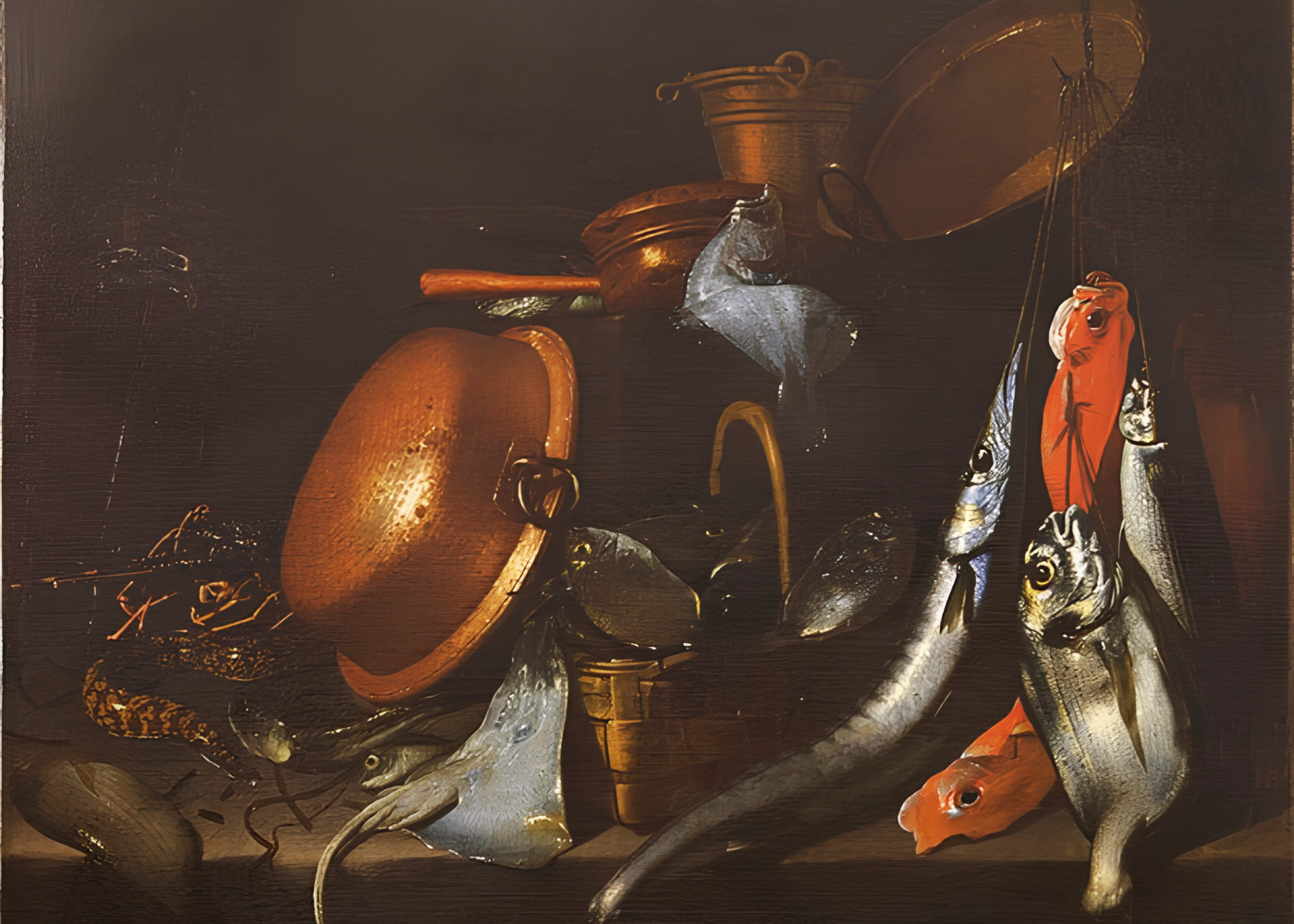
Fish, by contrast, was more approachable, given Napoli’s status as one of Europe’s great fishing ports. Red mullet was about 29 grana per rotolo, while sardines were 18 grana per rotolo.

So the portiere must have been a very lonely and skinny guy, but I imagine that those nobles crossing the bank’s footstep would gift him something. I doubt it, though, because the nobility was cazz’ e cucchiar with the crown (a Neapolitan idiom that means two people are completely inseparable, getting along perfectly, and always found together), the viceroy of Naples, whose only goal was to extort taxes from the poor to finance Madrid’s wars.
From his chair, the portiere would observe a carriage approaching, drawn by a large horse and driven by the alfiere. He might look at the scene with contempt and think about his miserable 3 ducats a month, for that was a significant expense: the alfiere cost 0.5 ducats per day, and the carriage, along with the horse, would require at least 290 ducats.
This was Baroque Naples, the 1600s, when there were more painters than beds, and a good painter could earn between 3-4 ducats per week if employed by a dealer, or 5-8 ducats per painting from private patrons.
And I am sure the portiere must have encountered the famous Jusepe de Ribera, considered one of Caravaggio’s heirs. He must have gone in and out of the bank frequently, or maybe one of his servants, for he bought a house and a garden in Strada di Santo Spirito for 1900 ducats, and a villa in Borgo di Chiaia for 3100 ducats, which he rented for 100 ducats a year.
I believe the portiere had a very dynamic life, full of secrets and information, but that came with a cost: hunger.

Leave a Reply